An essay I wrote for the now-defunct Want Magazine. Published July 20, 2010
It feels serendipitous that, while closing our first release of Want Magazine, “The Engineering of Desire,” international attention turned towards one of its canniest practitioners.
Malcolm McLaren departed this world in April 2010, leaving behind more than just The Sex Pistols, Bow Wow Wow, and the proto-hip-hop single “Buffalo Gals.” He left a legacy that we as designers, marketers, and other UX acolytes would do well to examine.
No, seriously.

McLaren as UX Practitioner? “We Mean it, Man”
I can hear the flame war already. What can the life of the man who allegedly invented punk rock and brought hip-hop to Britain and suburban America teach we who design smart phone apps and touch-screen PCs?
More than you’d think. McLaren took a startup venture—consisting of four pimply youths who frequented his London fetish shop–and guided it to international recognition and a social impact that popular culture continues to reel from.
He did it by applying a fascinating mix of strategies–some, like denying customers access to his product, would lose today’s UX experts their jobs. Others, like conducting user testing and enforcing a focused product strategy, UX’s leading lights follow every day.
French Marxism Meets Kings Road Retail
From the beginning of his career, McLaren had a talent for picking up existing cultures and philosophies and re-framing them to create something new.
The latter skill came from his late-60s art-school education, where he discovered the political movement, Situationism. Founded by Marxist philosopher Guy DeBord, the Situationists advocated provocative, even absurd actions both as political statement and performance art. McLaren would eventually apply Situationist ideals to sales, management, and eventually, product strategy.
He began his career in retail. In 1972, McLaren and then-girlfriend Vivienne Westwood opened up a clothing store in London’s trendy Kings Road district called Let It Rock, selling Teddy-Boy-style-apparel like leather jackets and skin-tight trousers. Then, during a trip to New York, he discovered the DIY culture of punk rock and the hardware-heavy fashion of S/M fetish culture.
This influenced McLaren and Westwood to change the name of their store to Sex and sell leather and vinyl bondage gear. McLaren would later tell Vice Magazine, “I wanted to sell things that were normally sold in brown paper bags under the table. People were afraid to come in. It was fantastic.”
The store served as his Situationist comment on retail: “A shop in which nothing in it was for sale. I liked the contradictions of that. It turned our shop into a place that people found impossible to leave.” [Swindle Magazine]
Selling such disreputable items in a Kings Road boutique created the political volatility on which McLaren thrived. “We were raided twice by the police and went to court, but I didn’t give a damn…all the kids thought, ‘This is the coolest place on earth.’” [Vice Magazine]
The store failed to cultivate a customer base–but it built a hungry audience. McLaren would leverage this audience for his other products–not the least of which was a band, consisting of four of his most loyal non-customers.
“Cash From Chaos”
As he moved into the music industry with the Sex Pistols, McLaren continued to leverage his Situationist tendencies. He made sure every piece of media the band actually released had some element of inaccessibility–the beginnings of an anti-marketing strategy he would dub “Cash from Chaos.”
This strategy, unheard of today, had dual positive outcomes. One outcome was the creation of publicity.
The record, “Anarchy in the UK,” needed to create an eruption. After all, it was just a record and somehow that didn’t seem to be enough. I refused to put a pretty picture of a band on a cover. Instead, I instructed the marketing department to produce a plain black cover with no hole in the middle, no name, no title, no record label. Nothing. [The Guardian]
The other outcome was a targeted, passionate audience, much like the one he cultivated among the kids at his store.
EMI were not happy. How, they asked, will anyone find the record? They didn’t understand that I didn’t want just anybody to find it. I wanted only those who cared. [The Guardian]
But the chaos—and the cash—had only begun to accrue.
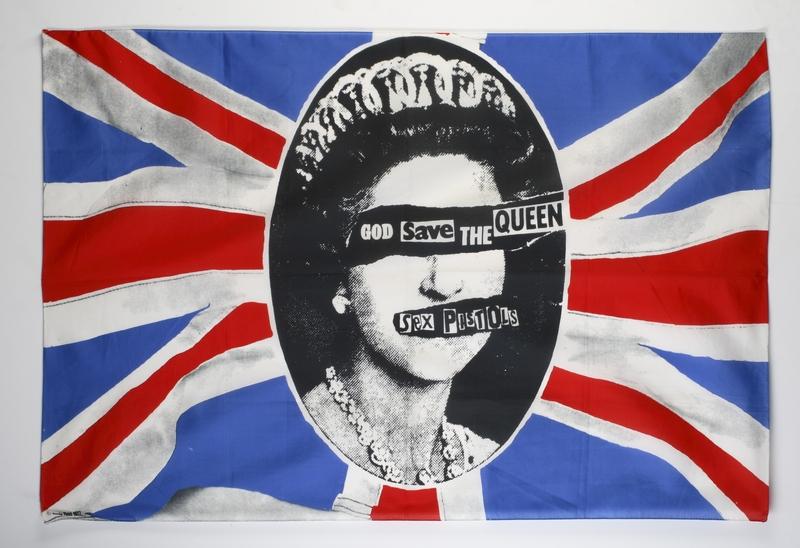
God Save the Queen (and the Band’s Reputation)
McLaren made it a point to keep the band away from its fans and the press—partly to maintain that sense of mystery and exclusivity; partly because the Sex Pistols were actually terrible musicians.
Creating an inflammatory image helped. The Pistols lobbed f-bombs on national television—unheard of at the time. Most infamously, during the twenty-fifth anniversary of Queen Elizabeth II’s accession to the throne, McLaren rented a boat and had the band float up and down the Thames performing “God Save the Queen” and “Anarchy in the UK.”
This offense on the media actually allowed him to keep his product under wraps, making the idea of the band more popular than their music ever could have been.
Instead of having the band play, I had them judge beauty contests. Town councilors were conducting press interviews. Whole towns and cities across the nation formed vigilante squads, not only to ban the group from playing but to prevent them from entering the city. Congregations were praying they just might self-destruct. The national debate was on. [The Guardian]
Creating this firestorm around the band, as he did with Sex, did the trick. “The fact that (people) couldn’t be at the event made the event an enigma that could never be resolved.” He told the musician Momus in 2002. “And that’s what kept the Sex Pistols on the top of the media pile for eighteen months.”
Shared Experience: Four UX Rules McLaren Followed
Keeping one’s product away from prospective buyers rarely leads to platinum sales, as it did with Never Mind the Bollocks, Here’s The Sex Pistols. But looking at the techniques and opinions of some of the leading minds in UX–specifically, those interviewed in Want Magazine’s Release 001–McLaren might not have been all that off-base after all.
1. Have a tightly-focused product strategy.
Take Luke Wroblewski’s interview, wherein he praises the efficacy of the single-focus product strategy:
Many times that (drive) comes from an entrepreneur who has that very, very strong desire. That personal drive to bring something to the world…is an incredibly strong focus point. I think this is why a lot of early-stage companies can deliver something new to the world.
2. Don’t Listen to your users. Watch them.
McLaren relied on user testing–or at least his version of it. He founded punk style by observing the clientele of Sex, his Kings Road boutique. He noted the ones who most frequented the store bought very little, but rather, hung out for the scene, for the style. Malcolm described them in an interview as “The dispossessed fans of David Bowie, Roxy Music, et cetra, who were looking for something of their own.”
3. Find your user’s unmet needs or wants—and meet them.
In our interview with Cordell Ratzlaff, Cisco’s Director of User-Centered Design, he mentions that “A lot of the emotional connection that people have with products goes back to satisfying a need that they didn’t even know that they had.”
As McLaren developed an understanding of what his audience wanted—even before they themselves did–he created ways to capitalize on them without compromising his product’s authenticity. Volatile publicity stunts like the Queens’ Jubilee boat trip resulted in “God Save the Queen” reaching #1 on the British pop charts–building the band’s anti-authoritarian image and moving units at the same time.
4. Cover flaws with an overall enjoyable User Experience.
The cleverest UX strategy applied by McLaren is one referenced by none other than Don Norman. In Norman’s Want interview, Norman applies it to the most un-counterculture experience around: amusement park lines. Norman points out that amusement parks can do little about the lines for their rides, and so try to make every other aspect of the park experience pleasurable.
By making the total experience a great one, people are willing to overlook the minor problems of boredom and standing in line…When something is really good and pleasurable, we do overlook the minor faults.
Which, of course is exactly what McLaren did—i.e., use a publicity smokescreen to hide the fact that the experience of watching the Sex Pistols play was actually unpleasant. While this is a strategy Norman acknowledges, it’s not one he’d have recommended.
I would hate to have that used, though, as a way of deliberately allowing ourselves to have faults and making up for it by some other thing, say by the packaging or styling.
As such, it’s unlikely that Don Norman would approve of the Sex Pistols.
Steve, Malcolm. Malcolm, Steve
McLaren melded disparate elements of culture and politics as a UX designer or strategist does with metaphors and design patterns. He knew how to create ideas at the big-picture level, and shape and lead a team that could execute on them.
Was his ability to combine fringe cultures of late-70s New York City with fashion retail to create a million-selling rock band terribly unlike today’s product innovators? Is it so different from Steve Jobs, who looked at a hotel concierge desk and thought “Genius Bar,” or Jonathan Abrams, who took a Match.com profile as his inspiration for Friendster? Can’t innovation come from anywhere, into any industry, provided it’s sufficiently fueled by passion and imagination?
If Malcolm McLaren’s career is any indication, of course it can. Part P.T. Barnum, part Fagin-esque entrepreneur, he spent his life trusting his gut and failing as often as he succeeded. Yet his successes influenced design and technology in ways most of today’s innovators can only dream of–all with a minimum of cash and resources; mostly wit, drive, and an eye for talent.
Perhaps it’s that path to DIY success where McLaren truly resonates with us in the UX field. His work permeated our culture in a way that today’s tech start-ups aspire. “If you play your cards right,” He ranted in the film The Great Rock N Roll Swindle, “You can capture the imagination of the entire world.”
by Ken Grobe
Managing Editor, wantmag.com
Ken Grobe is a UI writer, editor, and award-winning copywriter. When he’s not helping Want Magazine to increase the general profile of User Experience, he writes comedy for San Francisco’s Killing My Lobster.
Thanks to David Gomez Rosado for procuring the McLaren Photo.








 Some of you know that umpty-ump years ago, I worked in New York City as a comic book editor. One of the books I helped
 The historical background you need to know is this: The Viet Minh dug tunnels in the 40s and 50s in order to hide from, escape from, and otherwise fight the French. In the 60s & 70s, the Viet Cong used them to do the same for the US.
 Shot with my crappy phonecam but