Don Norman: The Want Magazine Interview

One of the interviews I conducted for Want Magazine. Published May 14, 2010

The ability to explain complex academic theories in palatable layman’s’ terms is the mark of a good teacher—and Don Norman is certainly that. “Don,” Adaptive Path founder Peter Merholz warned us, “likes to take people to school.”

He is, of course, much more than a professor. Often called “The father of User Experience,” Norman coined the phrase some two decades ago. He’s the co-director of the dual-degree MBA and Engineering program at Northwestern University. Professor. Author. Ground-breaking usability theorist. Being taken to school by someone in his league, I can deal with.

I arrived at his Palo Alto home with pad, pen, and camera crew to chat with him about the “Engineering of Want,” the theme of our maiden issue. I left with a surprisingly environmentalist critique of product design, a preview of his new book, Living with Complexity, and the idea that the ultimate state of UX is for it to disappear. Oh, and he accused me of being a marketer.

HCI & UX: Re-Framing the Big Picture

Norman began our lesson as soon as I asked him our first interview question: “What were the fields of User Experience and HCI like when you started?” He chuckled and pointed out that, back in 1989 (when he wrote the seminal The Design of Everyday Things), there was no HCI. “My research group and I had been looking at the problems of Unix and the problems with these clunky terminals. We didn’t yet have graphic displays.”

These early days of (non-)UX were marked by a lack of decent user interfaces. “In the beginning,” Don explained, “We really had to think about usability because the early computers, and for that matter almost all early products that used computers, were unworkable, unusable, not understandable—because they had tended to be [designed] by engineers, who were much more concerned with ‘Could we even get the thing to work?’…And we had done the book called User Centered System Design, which, I guess, you could say was the early days of HCI.”

Norman agrees that the field of UX has come a long way since then—in our thinking, if not in execution. “Now, lots of products are still unusable, but the principles of how we should make them usable are very well known, and they’re really not changing.”

“I think that we no longer need to focus. The usability people really have to focus on doing best practices or making sure that what we know, how we know to do things should be applied.”

Norman’s take is that we, as an industry, should agree on UX best practices and move on. To where, we wondered? He was glad we asked.

“The Real Focus is System.”

Norman’s impending new book, Living With Complexity, covers what he feels is the next level of usability—being part of a system. Lest you suspect that the author of The Design of Everyday Things has joined the Borg, he provided an example from everyday life. For a taste of his teaching style, here’s a short transcript:

Don Norman: Look at the iPod. Why is it successful? Is it a great music player? Yeah, but is it much different than the other music players? No.

Want: One might suggest it’s a more elegant interface design.

Don Norman: Barely. The others are easy to use. They’re often less expensive. They often have more memory. The basic player is not why the iPod is successful.

Want: iTunes?

Don Norman: Well, no, but you’re in the right direction. You may remember that in the really old days, it was hard to get music, and on top of that, it was illegal to do so. You really had to be pretty technical. Apple was the first company to do the licensing. So, first of all, they made it legal; second of all, they made the price sensible. Then they took a big database, an SAP database, and they made it usable, and that became iTunes. They made it easy to go there and find the music you wanted. They made the download effortless. You plug the iPod in and without doing anything, your iPod is up to date. And they also allowed other people, third parties, to build all sorts of accessories like external speakers. Those people are part of the ecosystem that Apple provided.

“So,” Norman said, summing up his definition, “We have a system that, under the surface, is incredibly complex, but at all touchpoints, is easy and enjoyable to use—from the licensing on the one end of music, to the licensing on the other end of third parties who are providing all of the accessories that expand the utility of the iPod. And everything is effortless.”

So Complex, It’s Easy.

Complex under the surface, but easy to use: that’s the future of products and services, according to Living With Complexity. “People think the opposite of complexity is simplicity, but it’s not.” Don explained. “People who say, ‘I want it simple,’ want it understandable and usable.”

Norman’s new book argues that just because a product is complex, doesn’t mean it has to be difficult to use. “The problem with complexity,” he says with his trademark grin, “is that it often leads to being complicated. ‘Complicated’ is in the head. If we can make a complex thing that is understandable, then, in fact, we like it, because it gives us a lot more power.”

What is key to understandability? Good design plays a big part, by helping to make things modular. “You do that,” he suggests, “by providing a good, cohesive model so there’s a conceptual model; you do that by adding structure; and you do that by also learning it in small hunks.”

Your product or service should provide a simple return from basic comprehension, and offer greater returns the more you learn it. Take iTunes: playing a song on it is easy. But as you learn each of its features, like playlists, the Genius function, syncing it with a portable device, you get more enjoyment out of it.

Norman cited cars and cell phones as other examples of this—but the one that he kept coming back to was cooking.

“You learn cooking slowly, over time. You start off by making, I don’t know, boiled eggs, and you slowly learn how to make scrambled eggs and omelets, and so on. You work your way up.

“Every little tool that we use in cooking is pretty simple. Cooking itself is made up of many simple steps, but the large number of simple steps, and the need for proper timing and the need for knowing what goes together, makes it a complex activity.”

Are the “Engineers of Want” the Enemy?

Keeping with our theme for Release 001, we asked him if it was possible to engineer “want” into a product or service.

“It’s interesting,” he remarked after a thoughtful silence, “that what we’re doing is sort of moving the user experience and design world into the world of advertising.”

And so the interview took a fascinating turn. The single question gave him plenty of reason to opine about consumer industry and its drive to iterate constantly in order to drive sales. Don, ever the academic, believes that advertising and marketing “create desires and wants and needs that never existed before.”

“Think about the environmental mess that we have…Is it really necessary to discard your cell phone every six months or every year or even every two years? Is it because the advertising community has figured out ways of, oh, wow, giving you some new feature you can’t live without? So maybe it’s not a good thing that we create these wonderful desires for something new that we don’t have.”

“Remember,” he advised, “the design world and the advertising world are not that far apart.”

Lest my Editor-in-Chief and I (both marketers at points in our careers) feel completely to blame, Don let us off the hook by tracing the origins of this iterate-to-sell point of view.

“It came from automobiles: deliberate styling to make your automobile obsolescent in one to two years. So there would be a model change every year in automobiles and every three or four years there’ll be a big change. And then the advertisers made it feel that you were evil—out of date—if you didn’t have the latest version.

“But is that any different than, ‘See, you have one of those old, clunky iPhones or one of those old, clunky iPods?’…The new ones are prettier and smaller, but the music sounds the same.”

“See,” Don offered with a wide grin, “The user experience community thinks they’re pure.

“’No, no, no!’” He added, lightly mocking product designers and usability experts everywhere. “’We don’t do that evil advertising stuff. We’re not doing evil marketing. We’re simply finding what people really want, and we’re providing it for them.’ Every six months, though, we provide new wants. Come on, what’s the distinction between that and what marketing does and what advertisers do?”

The Computer Becomes Invisible

Norman does concede that product line evolutions can offer significant leaps, rather than wasteful stylistic iterations: going from cell phones to smart phones, for instance. In fact, that’s the direction he sees the future of computing heading.

“What I’ve always advocated…and I think is happening, is that the computer disappears. [Take for example] the book reader, the specialized device just for reading books. Inside, it’s a computer, but who cares? A music player–a specialized device for listening to music–is a computer.”

iPad: Makes Great Fries!

Does this mean that we’ll see more products containing PC-level computers? Norman believes so, for better…and for worse. I mentioned the debut of a new line of microwave ovens with web-browsing ability, which amused him to no end.

“Too many times the technologists say, ‘Oh, gee, we could make a microwave oven that browses the Internet.’ Well, what for? ‘Oh, you could look up recipes on it.’ But if you actually think about the way people work, they don’t want to stand in front of their microwave looking for recipes.”

Which brought up a computer that he did consider a helpful device in the kitchen: The iPad.

“Suppose I’m thinking, oh, let’s have something different for dinner tonight. How do I do it? First of all, I peruse my memory and my knowledge of cooking and also my knowledge of what we have in the house to figure out what we might do. But I might turn to my cookbooks. I have a row of cookbooks there, and I might pull one out and read it.

“But why not…a portable reading device? It’s convenient to use. I don’t have to go to my office and sit under my desk. I can go to my couch, or I can sit here at the table. The new Apple iPad…would allow me to find recipes, maybe browse the Internet for cooking sites and see pictures, or if I’m not sure how to do the preparation, there’s a little video…People will start writing cookbooks not with photographs of the food, but with videos.

“But the nice thing is…not that suddenly the Internet gives us information—it already does. It’s that it gives it to me in the way I want to think about cooking. That’s what I think is going to be so powerful. These devices now will fit our lifestyles instead of us changing the way we work.

“When we look at the way things will come together, it’s going to be based around people’s activities, not because the technology suddenly makes it possible for your refrigerator to show TV programs,” he added with a professorial smirk.

Good Design is…Well, Advertising

And yet, we still hadn’t gotten Norman to address “the engineering of want” to the level we, well, wanted. Perhaps we never would. But it was worth another try.

We decided to address it from an angle he had established in his book, Emotional Design. There, he outlines three levels at which people process the products they buy and use: visceral (styling & perception), behavioral (look & feel) and reflective (one’s self-image that comes from the owning/using of the product).

Then we asked him how one could use those levels of emotion to instill want or desire into the creation of a product…and then he went off on a bit of a rant. But just a bit.

“Hmmm, here we go again. Doesn’t that make designers somewhat into advertisers or marketing people because we’re asking, ‘How do we make it so people should enjoy the product?’ Now, that’s not entirely fair, because why not make it so people really enjoy the products?”

A fair question.

“But yeah, make it attractive. Make it so it really feels good. That’s why we like precision tools. That’s why as a cook, I really like a well-balanced knife and good tools for cooking.”

“The question is the balance. We don’t want to sell things simply because we figured out how we can sell things: ‘Whether or not people care about it or need it, we’re going to make them care about it.’

“But if you can sell things that people really need, that really do make their lives better and do not destroy the environment, then sure, the distinction between designers and marketers, I think, is very small. Both of us are trying to do what the customer wants. The goal of marketing is to understand what people are willing to buy, and the goal of designers is to try to understand what people really need, and these groups really ought to be working closely together.”

All edifying and fine food for thought. But we still wanted to find that secret sauce. I pressed the issue from yet another angle:

Want: You’ve also written about how emotional attachments trump practicality. How much of that can be an exploitable trait when seducing audiences, when creating customers and of course the making of successful products?

Don Norman: Gee. You really are a marketing person, aren’t you?

Want: How did you know?

Don Norman: How much of that could be used to seduce the customers, to have them buy this, or have them overlook the horrible flaws we have on this side because this part is so wonderful and attractive?

Marketing as Damage Control

Which brought up an interesting point: How much of marketing and advertising is about promoting a product’s good points—and how much of it is about covering up flaws?

“You know, it’s interesting that all of this can be used to exploit people. Because…when something is really good and pleasurable, we do overlook the minor faults…We recognize that we can’t make everything perfect, and so we try to make a total great experience.

“One of the standard stories I tell is going to, say, a Disney theme park. I ask people what they hate; invariably they hate the lines. ‘[But] would you go back?’ Yes, most people would go back.

“The point is, the lines from Disney’s point of view are unavoidable. There’s no way they can prevent the lines because the only way really to prevent the lines is either have the rides be shorter or have more rides. But rides are very expensive: $10 million, $20 million a ride. They can’t put in many more rides. So here’s a case where all that I’m saying works: by making the total experience a great one, people are willing to overlook the minor problems of, you know, boredom and standing in line. But they didn’t deliberately put a negative in. They didn’t know how to get rid of the negative, so they made the surrounding experience positive. That’s what I like.”

“And so, with all of our products, which may have some unavoidable negative components, yeah, make it good, but I wouldn’t seduce them by saying, you know, we actually know this part is crap, so we’ll make this part really wonderful and maybe they won’t notice.”

“I would hate to have that used, though, as a way of deliberately allowing ourselves to have faults and making up for it by some other thing, say, by the packaging or by the styling or something else. I would hope that we do our very best.”

Finishing Up (at Northwestern)

Recently, Norman announced that he’d be retiring from his position at Northwestern University later this Summer–which, as he writes on his website, “…will let me do more consulting, travel more, stay longer, and be more spontaneous (but I’m booked until early 2011).”

Even after three-plus decades of ground-breaking work, Don Norman is by no means slowing down. Anyone who might suggest that he’ll be teaching less has not had the pleasure of interviewing him.


Thanks to David Gomez-Rosado for his help with this interview.
Okay: NOW it's done.

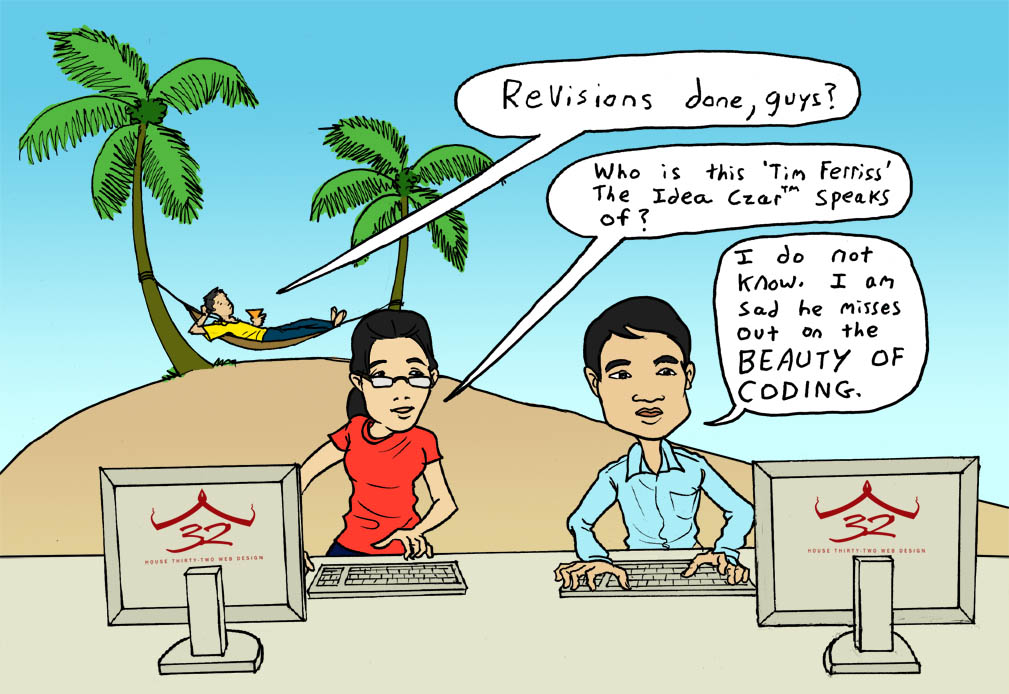
Thanks to Phnom Penh web design shop House 32 for taking my blog and bringing it in line with my new site design. They're run by an expat college friend of mine and crank out Internets like it ain't no thing. In fact, they even teased me for offshoring my blog design TO THEM, sending me the cartoon below in commemoration of completion. Now that's SOIVICE!

Cartoon from House 32 about their work on my blog re-design

Sadly, I have never read Tim Ferris's books, though I did almost sublet my apartment to him. But I HAVE been to the House 32 offices in Cambodia and they know their stuff.

Thanks, House 32! You guys and gals are consummate pros. Oh, and I'll have another Mai Tai, please.

Latest video: PLANET OF THE APES ORIGINAL ENDING

Written for the Fall Killing My Lobster show, the Sci-Fi-themed Killing My Lobster Conquers The Galaxy. I've always gotten a kick out of the bombastic Mr. Heston, and besides, why should the Statue of Liberty get all the props? We had a hell of a time matching the classic footage, and getting the audio on a beach where f**king cargo ships blare their horns every ten seconds. But I'm over the moon with the results.

Acted by the ever-charismatic Calum Grant, shot by the excellent Jon Burton, and written & directed by me. But watch it anyway, won't you?

I'm a Wedding Writer!

I've been living up to my multi-hyphenate hype more then ever lately. Over the past year, I've written several pieces for the gorgeous glossy Weddings In Houston Magazine. It's no secret that weddings are a boom industry, and few places more so than Houston.

I've had the opportunity to write several fashion profiles and a wedding photography primer...with more pieces on the way. Check 'em out if you're of a mind!

Profiles in Elegance: Judd Waddell

Profiles in Elegance: Reem Acra

Profiles in Elegance: Monique Lhuillier

New Video: "The Phone"

Don't worry, I didn't direct this one. Fellow Killing My Lobster-ites Chris Parisi & Damon Brennen asked me to play "a surly scientist" in this video, and as they make killer vids, I rushed to accept. Written & shot for the latest KML show, Killing My Lobster Reboots, here's "The Phone":

http://www.youtube.com/watch?v=LvKeO9Q6CII

It's been up for about four days and has topped 53,000 views as of this writing. No doubt as a result of my bravura performance. Enjoy!

Want Magazine in Communication Arts

Thanks to the fine, discerning folks at Communication Arts for making Want Magazine their Web Pick of the Week! It's always a pleasure to see a project you've put your heart and soul into get props.

Although sometimes I wonder what anyone who Googles me must be thinking: "Waitaminute...the guy getting press for interviewing UX legend Donald Norman and the guy getting press for making videos of talking burritos and hipsters getting punched...IS THE SAME GUY?" Yes he is, Google-stalker with bad grammar. Yes he is.

A Day Job and a Dream

This latest KML video has a special place in my heart--and not just because I co-wrote and co-produced it. It's because I've spent the better part of my career juggling vocation and avocation. When I was an editor, I would write prose and comics scripts on nights, weekends, and, one very lonely Key West holiday. While in advertising, I performed weekly gigs with an improv troupe, wrote and produced a sketch comedy show, and played Joe's Pub and CBGB with my comedy/rock band. My point being, more often than not, I've used my day job to fund the stuff I loved.

That's what inspired our second of the two "Feed the Lobster" campaign spots: There's just too many of us out there with a day job and a dream.

[youtube=http://www.youtube.com/watch?v=zu-sCUAQzmo]

Ably directed by the legendary Chris Parisi and my co-writer/producer, Miriam Wild-Smith. See for yourself, feel free to donate, and have a great 2011.

"Feed the Lobster" in the SF Egotist

If there's one thing I've learned from my comedy-rock-band days, it's to be grateful for any press, good or bad. So I feel extremely fortunate that two of my KML videos received positive pixels within a day of each other! The SF Egotist, my favorite resource for local Advertising industry news, just big-upped our Feed The Lobster year-end appeals campaign, calling us "a great tax deduction." That's miles better than what AgencySpy called me the other month over "Coffee Wars." And no, I won't link to it (although I'm still grateful for it!).

"Coffee Wars" in the Bay Citizen

From my flu-sick-bed, I sat--okay, laid down--for an interview with Thalia Gigerenzer of The Bay Citizen, a very cool and objective BA news source. She wanted to know about The Coffee Wars and how much it holds a mirror up to SF coffee culture. I was not at the top of my game, but my answers were surprisingly coherent, if a bit rambling. I'm a rambler. Read the article here. The article, in turn, seems to be touching off another twitter-eddy (tweddy?) of activity about the video, which I hope leads to more YouTube views etc. It's pushing 65,000 views as of this writing!

[youtube=http://www.youtube.com/watch?v=oMqutKBS5iE]

Unfortunately, I wasn't lucid enough to plug my latest KML video, Feed The Lobster: Costumes, which could use more views, as we made it to generate donations to KML itself. See that vid here.

Thanks to Thalia and Queena Kim for their interest and for the coverage!

Feed The Lobster.

Folks, my latest video for Killing My Lobster is up and I'm proud as hell of it. It's an ad for, what else, KML. They're a non-profit, after all, and they provide a valuable service for the Bay Area and beyond: make people laugh. If you're down to donate a couple of bucks, please do.

[youtube=http://www.youtube.com/watch?v=LVnbOS9RmvI]

Thanks to the fine folks at Goodby, Silverstein & Partners, who loaned us their ArtWorks studio space, and GSP's Eric Herron, who helped us out with equipment, elbow grease, expertise, and good humor.

Directed by me, co-written and co-produced by my buddy Miriam Wild-Smith, and costumed, acted, and edited with love by a plethora of Lobsters. Enjoy!

"Coffee Wars" boils over!

[youtube=http://www.youtube.com/watch?v=oMqutKBS5iE&hl=en_US&feature=player_embedded&version=3] I've spent a sizable chunk of my spare time this past year writing and teaching for Killing My Lobster, the Second City of San Francisco. And while I feel like I spent the first few months making my bones, earning the respect of my talented co-writers and our equally gifted actors and directors, I like to think I've gone on to acquit myself over this year's shows.

The latest, and possibly most satisfying, example of this is the film I wrote and produced for Killing My Lobster Holds the Mayo, their final show of the year. The film is called The Coffee Wars and it's a Ken Burns parody, showcasing the rivalry between two of the best-known (and my favorite) artisan coffee brands in town.

It's blown up beyond all (well, my) expectations thus far, garnering over 8,00014,000 hits in less than three days, and crazy amounts of Twitter chatter. It's even attracted a hater or two, which is always a sure sign of online heat.

Kudos to director Rand Courtney, actors Fred Wickham and Sarah Mitchell, and the rest of the superb cast, crew, and musicians who made this film such a joy to make and, I hope, to watch. With apologies to Joan Baez.

Introducing Want Magazine

Want Magazine home page W is for "whew!"

The project I've been working on diligently for the last six months, Want Magazine, is up and looks amazing. Kudos to my Editor In Chief, David "Dahveed" Gomez-Rosado and our incredible staff. I wrote and/or edited some articles of which I couldn't be prouder.

Want Magazine iconWantMag is chock full of learnings and observations about the field of User Experience, as well as product design, architecture and marketing. But not boring. Really.

One of my particular favorite things about the mag is our video interviews, conducted with some of the leading lights in the field. Here's my interview with the man who coined the term "User Experience," Don Norman.

And here's one with the founder of UX agency Adaptive Path, Peter Merholz.

Plenty more to be found at Wantmag.com. Have at it! And tell 'em Ken sent you.

The wet and the dead: India day 30 (Haridwar) Part 2

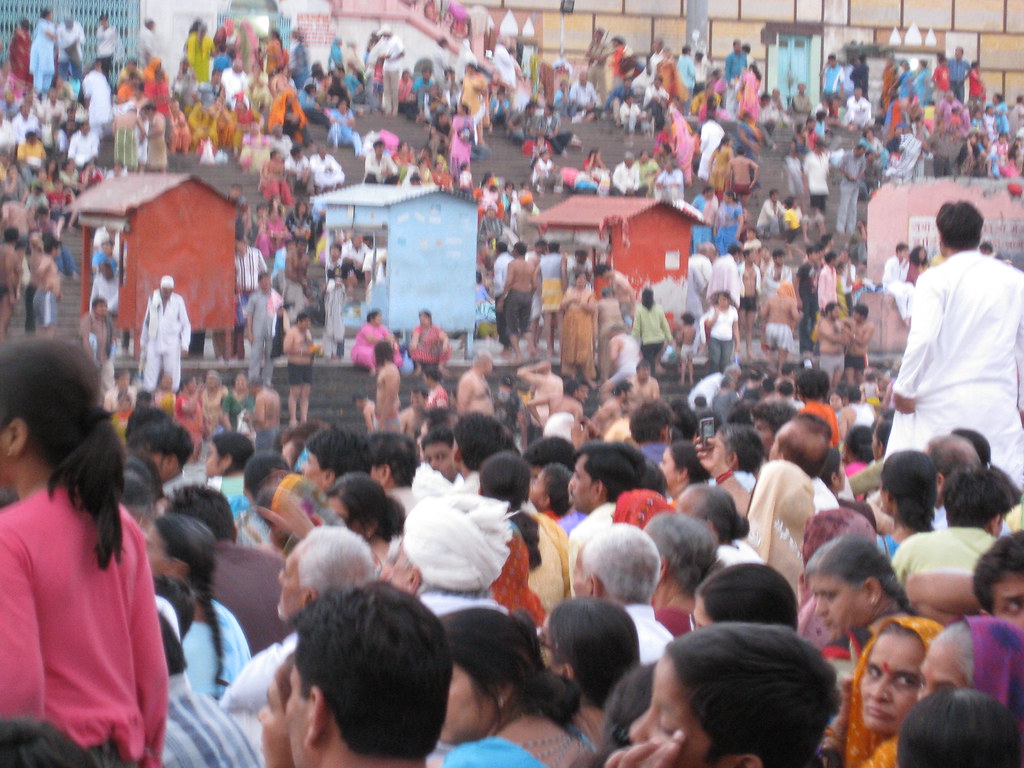
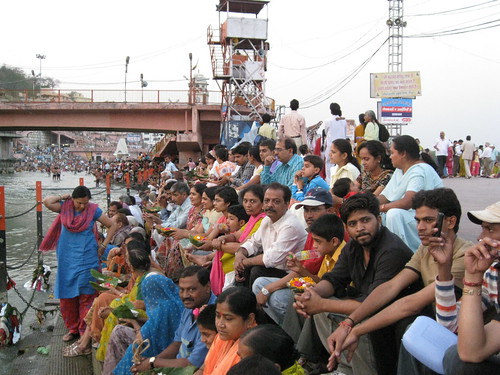
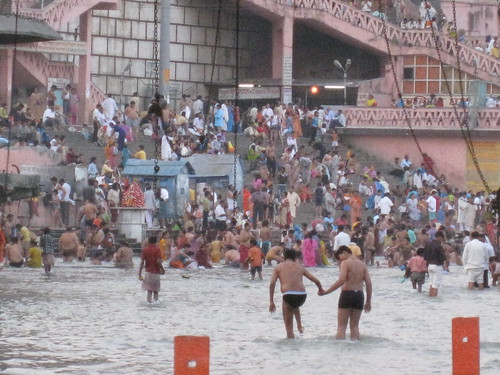
Here in Haridwar, at the source of the Ganges river, people go to the ghats here to purify themselves in the waters. But every night thousands come here to honor their dead. So, just before sunset, we set out to the river Ghats, for the sunset ceremony.

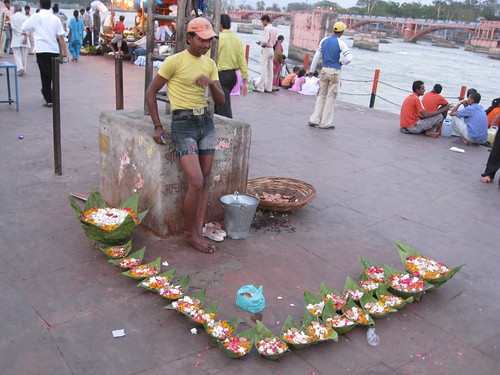
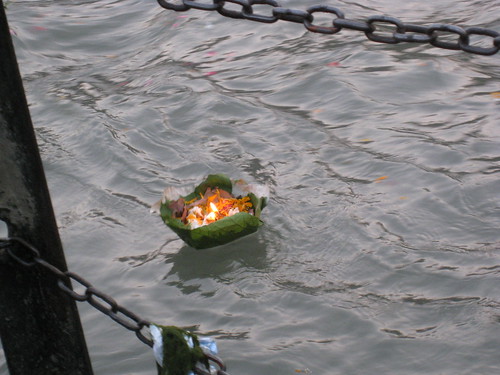
When we got there, people were sitting on the steps and platforms for probably a solid half-kilometer of the river, most of them purchasing or already holding small floats consisting of leaves, flower petals, and a small candle. We snuggled in on the steps among the mourners. Across the Ghat from us, a family poured ashes into the river from a plastic shopping bag, then bathed themselves in the water, openly weeping.

Occasionally someone in a uniform would shout orders at the crowds, in a tone that seemed more explanatory than harsh. I’m pretty sure he was telling all of us how the ceremony would go, what to do, and when. Occasionally he would reach his hand into the water and splash everybody, making him seem like some sort of jovial univormed tour guide. Natacha freaked out at having the water splashed on her, and I wasn’t too happy about it either. As it turns out, since it’s the source of the ganges, it’s fairly clean and extremely cold.

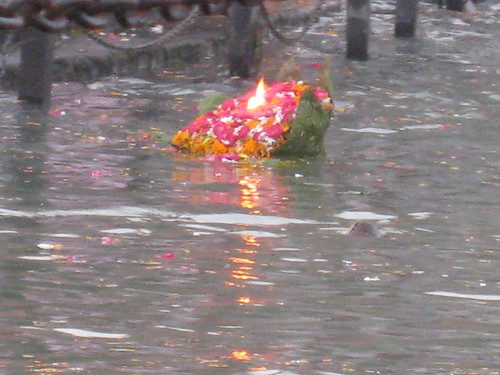
The sun set and the ceremony began. A number of people had jumped the gun earlier, but once the sky darkened, thousands of little floats, each lit by a single candle, made their way down the Ganges, each one a remembrance of a dead loved one.

Later in the ceremony, a main stage area had some bona fide fire rituals, using torches and loud chanting. That was something to see.

I took dozens of pictures of this very beautiful (if frenetic) ceremony.

Natacha bought these crazy handbags made from unused sheets of product wrapping—M & Ms, Friskies, etc.

Walking along the ghats after the ceremony was just as nuts, if not more so because everyone was on the move. It felt like walking on the bordwalk of a beachside holiday town…or rather, four holiday towns on top of one another. So much to see!

There were people swimming in the cold, strong-current Ganges, changing in and out of swimsuits in tents along the ghats. At night! People walking from temple to souvenir stall to restaurant to temple again. Food stalls. Red-powder stalls. It was nuts, and a little overwhelming.

That night we ate dinner at the same place we had lunch—it was a ways away from the ghats and as such nice and quiet.

But for some reason, a horn & drum band—not the one we saw earlier, I don’t think—decided to start playing across the street from the restaurant. With a PA and their own lighting, no less!

Nuts. But fascinating.

Day of the dead (and the just sleepy): India Day 30 (Haridwar) Part 1

Despite the early wake-up and extensive traveling, this was another tentpole day of the trip. The evening river ritual in Haridwar is an event that rivals that of Varanassi, without the twelve-hour train trip (or, at this time of year, the murderous heat). It was recommended to us by a friend of a friend, and we said what the hell. The train up was relatively uneventful. We chose the higher-class section this time, thank you, and got soft  seats and food & water served to us. While waiting for the bathroom, I struck up a conversation with an old man in spotless white robes. He had one of those crazy-eyes old-men faces, and took great pains to tell me that Barak Obama is a muslim, and that once elected would unleash his secret muslim agenda on the world.

The guy was a classic old-school Hindu; he meant well, but had a head full of right-wing propaganda. He freaked me out enough that I quickly excused myself and hightailed it back to my seat.

So: an early train out of Delhi, dropping us off into an unfamiliar city at (as usual) the hottest time of day. For us, this was typical travel.

We looked for an i-café in the guide book, to discover that it had gone under. We searched for a tourist office, that was closed B/C it was Sunday. After walking aimlessly for an hour or more (and yes, snapping at each other b/c of the heat), Natacha & I did the right thing and tucked into an A/c restaurant with great food, and more important, A/c.

Haridwar is a true Indian tourist town. i.e. it’s all Indian tourists and no gringos. The town is the alleged source of the Ganges. There are three rivers that merge at Haridwar, becoming the Ganges, making this a holy place. The streets were hot and busy, and every so often an open truck with a marching band on it or an impromptou parade would come down the main street, banners, etc. Something religious, but I couldn’t guess what. Nuts.

And here’s something that fascinates me about India. Religion is intermingled with society in curious ways. In the case of Haridwar, it’s mixed with tourism. It’s one of the holiest places in India, but it’s like a holiday town: hotels everywhere, souvenir shops for days, and a hilltop temple surrounded by snack bars. Oh, and served by a cable sky-tram like something out of a ski lodge.

I guess it’s not that different from Mormons visiting Salt Lake City, or Catholics visiting the Vatican. I myself have a souvenir bottle opener with the Pope John Paul II’s face on it. I call it “The Popener.”

Of course, the Vatican doesn't have a creepy guy in a turban stick a live python in your face and say, "Picture!"  Does it?

After finding a cheap room (we were only staying one night, after all), we set out on the town, which really was this crazy mix of holy city/tourist town. We decided to take the cable car up to the holy temple, which was absolutely packed. Maybe because it was a Sunday? Who knows. The Temple was surrounded with little shops that sold a variety of things from flowers and other temple offerings to jewelry and ice cream to…one other thing I’ll mention in a sec.

At the temple, I heard someone calling out to me—it was spotted crazy old hindu man from the train. He was in fact with his family, but he’d scared me enough on the train that I exchanged a few words with him and then went on my way.

The temple was shoulder-to-shoulder, as we inched along the passageways, lit incense, had sandalwood paint touched to our foreheads, etc. I didn’t receive the paint because most people assumed the little white patch on my forehead was a holy marking (it was cream to heal the cut on my forehead).

The temple was beautiful, if cramped, and it felt weird that there were so many people inside it, lining up to get in, lingering around it, buying souvenir statuettes next to it.

But then, Natacha and I found this photo booth service thing.

You know those cheesy sepia tone photos you can take that make you look like y ou’re in the old west, or the industrial revolution? This hill temple had a “service” where they took your picture dressed up in traditional India costume. Bejewled robes, headpieces, even a sword. I talked Natacha into having ours taken. It came out superbly and is our holiday card this year.

There were sample pictures where  couple would have the sword, and the man would have it against the wife’s throat. That didn’t suit me at all…but I REALLY wanted the sword. So when we posed, we held the sword together. I think she held the hilt and I held the scabbard.

We then waited in a VERY long line to take the tram back down the hill, and who should we end up in line with but crazy old guy and his family.

It turns out that he’s not “crazy” old guy after all. He was actually a very sweet man who brings takes his family up from Delhi to Haridwar once a year for a day-long pilgrimage. They bathe in the river’s holy waters, visit the temple, and go back to Delhi the same day.

He even introduced us to his brother, and his adorable grandkids. He was so proud that one of them was acting in an upcoming school play, and was a pretty good hand with English. While waiting in line for the tram wasn’t that pleasant, it was very nice to spend some time getting to know this family.

I also took the best close-up picture of a monkey I will ever get. It didn’t even occur to me that it could’ve possibly reached through the fence & ripped my face off.

From hot to f@#%ing HOTTER: India Day 29 (Kochin to Delhi)

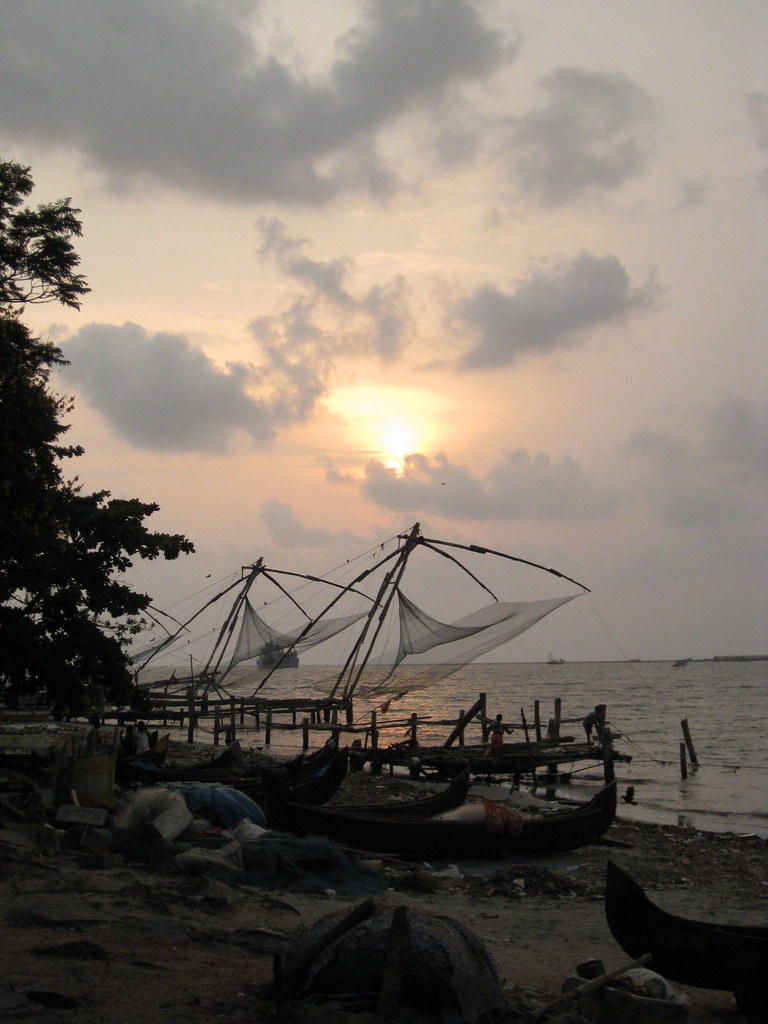
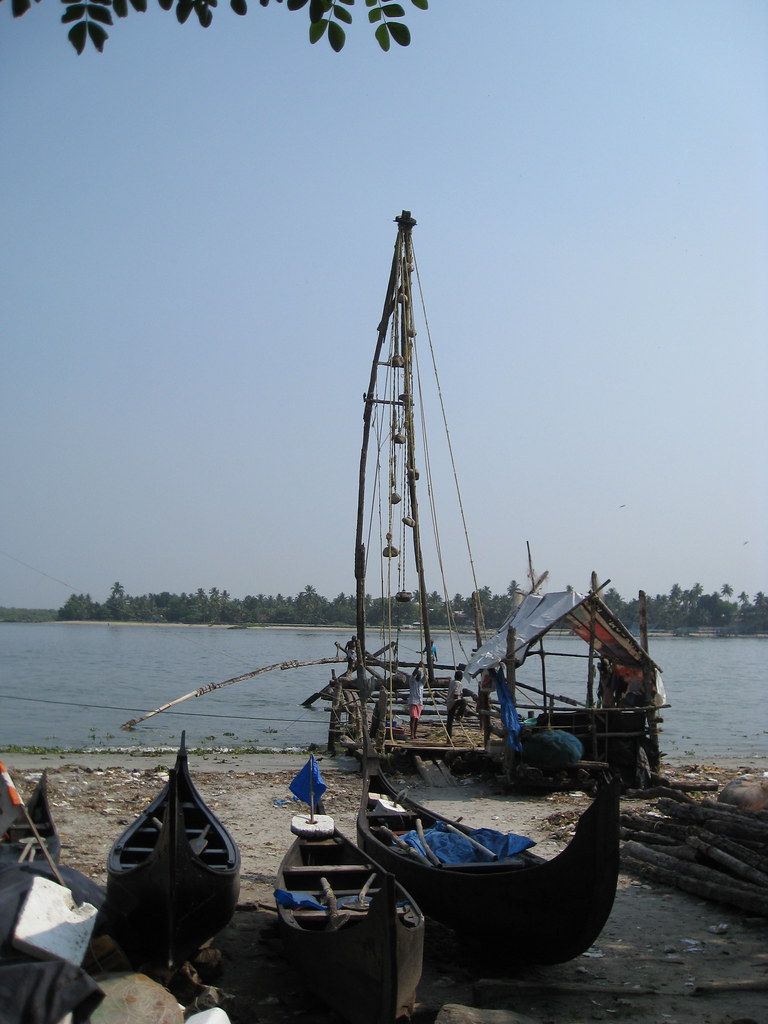
fishing nets near sundownTraveling in India in the second-hottest month of the year, we lamented the weather many times during our travels. But here we were, in the south of india, i.e., India, only hotter.

We liked Cochi as a town, liked the time we spent in Kerala. I mean, how could you not—Varkala, the backwaters, the 400 year old synagogue? It was the most humane, least mercenary time we’ve had so far in the country. But the heat was just too much. We had to leave.

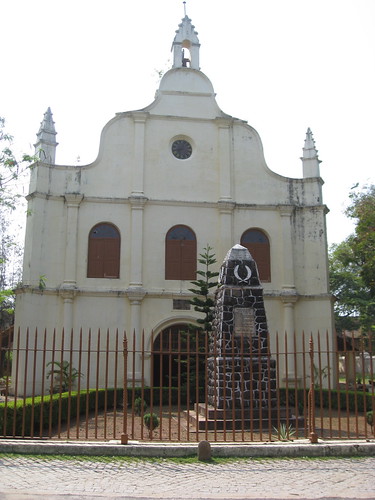
Catholic churchWe did take a walk around the town citadel, first, and saw parts of the town where I wished we could’ve spent more time in: The coast, with those huge Chinese fishing nets (we actually got to see those in action and they were impressive. Like a Gilligan’s island trap, only eight times bigger and they worked. We saw the area church (another centuries-old building), did a teeny bit more shopping, and piled into a cab.

The cab to the airport was about 90 minutes longer than we’d expected. Our driver, as it turns out, also fancied himself a psychic. He foresaw great career success for Natacha in the future—interesting since she’s going back to school for the next few years. I don’t think he predicted anything for me.

He certainly didn’t predict the hour or so of torrential rainstorms that started just as we entered the airport. Nor did he predict the dozens of soldiers that filled the airport lobby, after which they escorted out two guys in coveralls, lingered around a while longer, and left. But I imagine he could’ve predicted our plane would take off late. Hell, I could've predicted that. This is India, after all.

We got into Delhi around 8 PM, at which time the temperature was 40 degrees Celsius. At 8 PM. Fortunately, we’d reserved an AC room in a decent place.  Slept with the intent to get up crazy early for a train north, to Haridwar.

India.

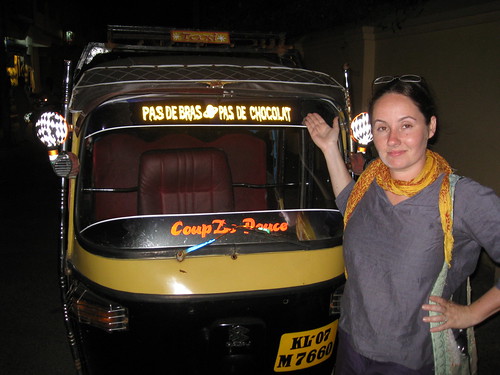
No arms, no chocolate

In which we find religion (our own): India Day 28 (Kochin)

Paradesi Synagogue, from my POV sitting at the pew

Photos of the Kochi paradesi synagogue interior courtesy of Wouter Hagens via Wikipedia Commons. We weren't allowed to take photos in the synagogue.

After a fun day of shopping, chatting, and exploring, we took a crack at going to a 400-year old synagogue for Shabbat. It was closed during the day b/c of Passover, but we were told that it might be open for the Friday service. Worth a shot.

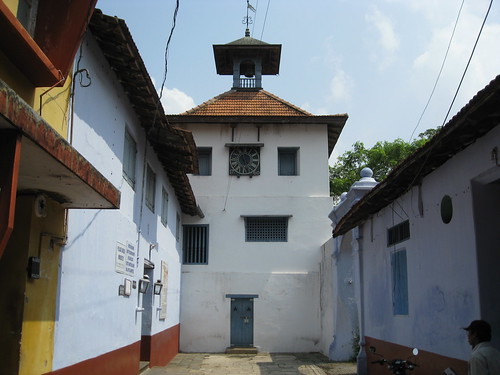
The 400 year old Synagogue (exterior)

Once there, a Keralan man told us that there would be a service, but that it would be a short one, as it was Passover weekend and there weren’t enough men around that weekend for a minion (people were visiting their families and whatnot). I think that man might have been a shabbas-goy or something.

Eventually, a thin little old man in his 70s (80s?) in huge glasses and a kippah showed up. He looked like a cross between an Indian Don Ameche and my Grandpa Ned. He spoke to the Shabbas-goy in Hindi, then asked us if we wanted to come in for Shabbat. We eagerly nodded yes.

He led us in, and we removed our shoes, even though he said we didn’t have to.

The synagogue was beautiful, oozing 400 years of history from every wooden pew, every mosaic’d tile, from each ornate chandelier and each of the hundreds of colored blown-glass globes hanging from the ceiling.

It was smallish for a synagogue—maybe the size of two winnebagos side-by-side, with maybe a dozen pews in the back, a half-dozen along one side, and a few long benches along the other side. The walls, the ceiling, the podium—everything was touched by a love for this place and its history. Multiple chandeliers hung down, as did the hundreds of blown-glass bubbles (sea-glass?) and other ornaments

The center podium was similarly ornate. The floor was bare. A few stacks of siddurim lay next to the center podium. The three of us were the only people in the synagogue.

The old man motioned for Natacha to sit on the women’s; side, and bade me sit next to him on the men’s side. He had decent English, with an accent that was part Indian, part almost Yiddish. I wish I knew the man’s history, but I didn’t want to pry.

He had huge thick glasses. I imagined him to be a long-lived merchant in the area. I took a prayer book and sat in the back pew next to him.

We talked for a while, mostly me answering questions about where I was from and about American politics. I so wanted to ask him about himself, his life in India, but I was a guest in a revered place, and I didn’t feel it was my place.

A heavyset man in a sarong and kippah showed up and spoke to the old man in Hindi, glancing at me briefly. They chatted for a bit, then in accented English, he asked me where I grew up. I told him, “Los Angeles. California.” He smirked and said, “Los Angeles. California. Like I don’t know where Los Angeles is.” He would tease me about that several times over the course of the evening. Turns out the guy was a teacher from Cleveland, dividing his time between India and Israel (which would account for the accent).

He then hammered me with questions about where I was from, my religious background, my job, all in that asserting-status sort of way that I find Israelis do. He asked me where I spent Passover, and criticized me for not finding somewhere to spend Passover in India.” The Internet,” he said. “look up India and Passover,” as if it was as easy as that. Hell, maybe it was.

Soon, we all settled down and the men started praying. I’d read what I could from the siddur, and look around this beautiful space, at the blown-glass spheres in the ceiling…

…and this feeling came over me. Like I belonged, in a way I don’t anywhere else. The fact that here I was, half-way around the world, and these people took me in; and that together we enacted thousand-year-old rituals together, ones we all KNEW…filled me with such a sense of connection, of belonging, that I got choked up afterwards.

II felt so grateful to be there, to be accepted. Particularly in a country where we’re so out of place.

At the end of the service, the old man had the caretaker guy open up the arc, and we got to see and touch the four Torahs, each with a breast plate that was one of the first things that the Jews brought to Cochin, centuries ago.

We did the Kiddush over the wine at the center podium, then separated as the regulars went home or went visiting. It was one of the most genuinely moving experiences I’ve had in this country. Or ever.

The Man From Viagra: India day 28 (Kochi)

One of the most consistent irritants when traveling abroad is this: people are constantly asking you where you’re from. Every tout and huckster.  Every schoolkid who knows three words of English. Every employee at every store. Every rickshaw driver. Without fail. I think part of it is to get your measure, and determine how much money you might have. After a while, it gets invasive and unpleasant.

The same thing happened to me when I traveled through Indonesia years ago. After a while, I gave joke answers. My favorite was “Disneyland,” but the locals just thought I’d said “New Zealand” so it didn’t work.

But upon entering Kerala, I made up another fake country name: “Viagra.” Natacha didn’t want me to do it. But I figured if I was going to get the same annoying question thirty times a day, I should have a little fun with it.

The first time I tried it was in the spice shop. The guys there barely missed a beat, looked at each other with a little confusion, and said, “That is a drug, yes?”

Busted.

Then they laughed. So not only did it backfire, but I basically told them I came from an ED drug.

But it sure felt better than saying “USA” for the four hundredth time.